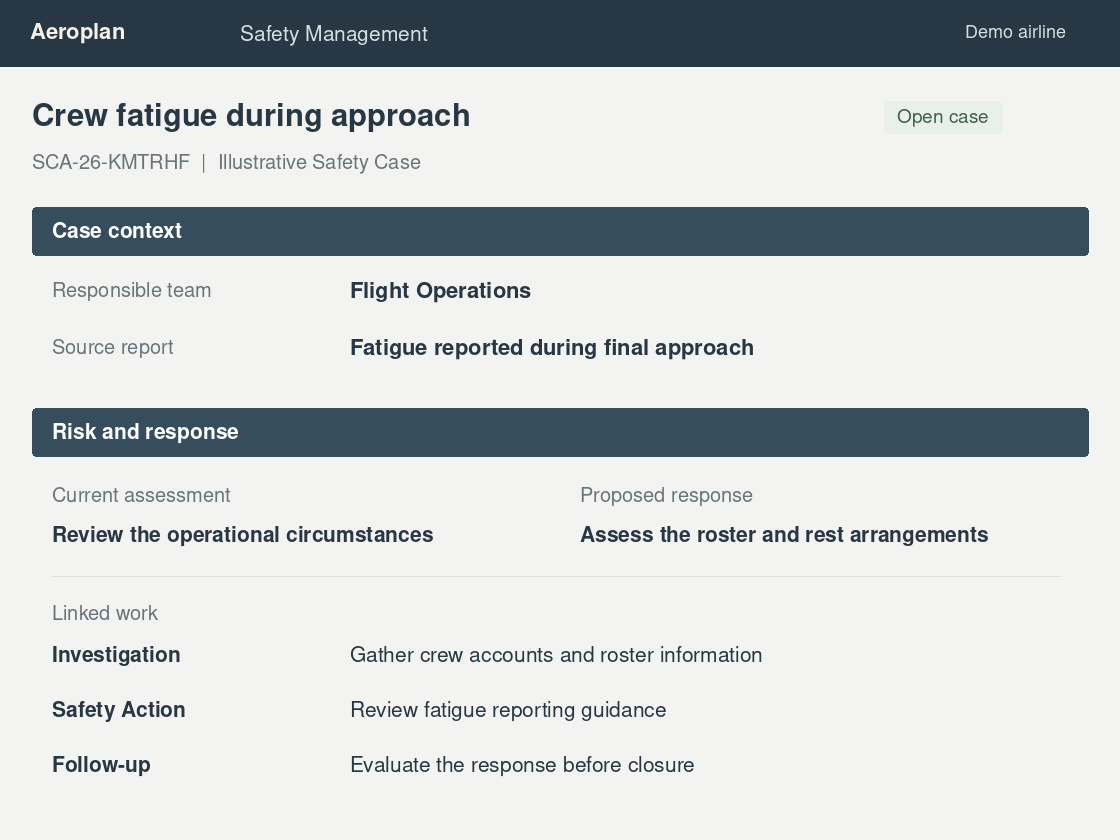
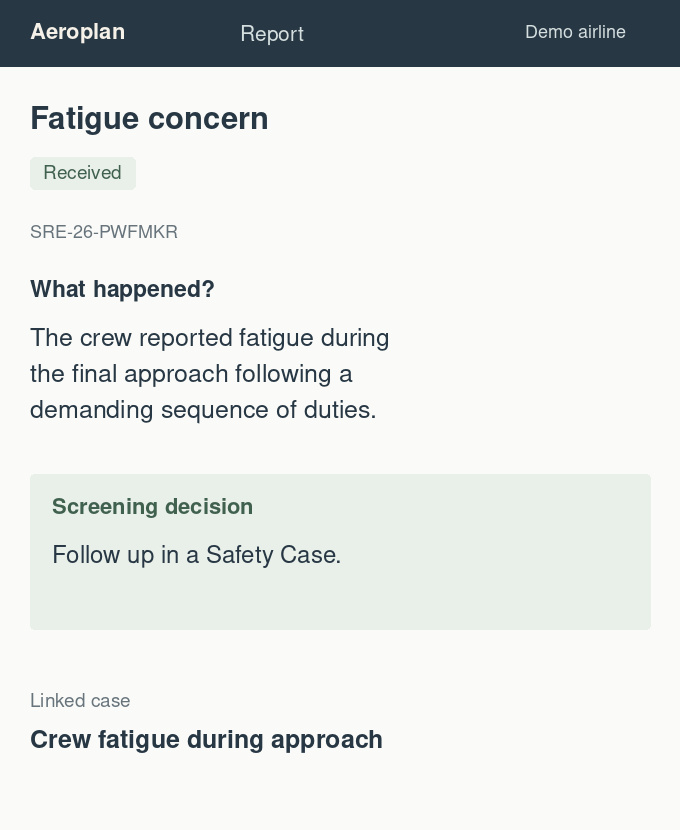
When someone raises a concern, your safety team needs to understand what happened and decide what to do. Aeroplan keeps reports, investigation and risk assessment together, so colleagues can follow the reasoning and take responsibility for the response.
Reporting and triage
Help people speak up about a concern.
A crew member may have a concern before they have all the answers. They can report what they know, including available aircraft and flight details, and choose to remain anonymous.
Your safety team can then decide what attention the report needs. Screening records whether it can be addressed during triage or warrants investigation in a Safety Case.
Make the reasoning easy to follow
Keep the decision, its reasoning and the responsible person with the report. A colleague taking over can understand why you chose that route and continue the work.
Keep notification details at hand
When you need to check an authority notification, its recipient, date and channel are available alongside the screening decision.
A concern from the flight deck
Keep the crew’s account with the investigation.
After an approach, a crew member reports fatigue. Your safety team can screen the concern and return to the original account while deciding what response it needs.
The crew member gives your team an account of the concern.
Crew fatigue during approach
Make the concern heard
The crew member describes the flight circumstances and fatigue, giving your team an account to start from.
Report received
The crew member gives your team an account of the concern.
Crew fatigue during approach
Make the concern heard
The crew member describes the flight circumstances and fatigue, giving your team an account to start from.
Report received
Your assessor records why investigation is needed.
Crew fatigue during approach
Explain why further work is needed
Your assessor records why the concern warrants investigation and creates a Safety Case. Colleagues can follow that reasoning.
Case created
The report stays available as the investigation develops.
Crew fatigue during approach
Keep the original account within reach
Your investigators can consult the report while gathering evidence, assessing risk and deciding on follow-up.
Investigation and follow-up
A concern from the flight deck
Keep the crew’s account with the investigation.
Report
Make the concern heard
The crew member describes the flight circumstances and fatigue, giving your team an account to start from.
Triage
Explain why further work is needed
Your assessor records why the concern warrants investigation and creates a Safety Case. Colleagues can follow that reasoning.
Safety Case
Keep the original account within reach
Your investigators can consult the report while gathering evidence, assessing risk and deciding on follow-up.
Investigation and risk
Give risk decisions a clear basis.
After a crew member reports fatigue during approach, your team needs to understand the circumstances. The duty pattern and investigation evidence give assessors a basis for considering the risk and a possible scheduling change.
With existing controls
Current risk
Assess the scenario with the controls already in place.
Proposed controls
Assess the scheduling change
With proposed controls
Forecast risk
Estimate the risk if the proposed change works as intended.
An expectation to review
The forecast records an expected effect. Evidence from operation is needed to assess whether that effect is achieved.
Compare the risk with existing controls against the expected effect of the scheduling proposal. Keeping those assessments distinct helps your team explain what it expects the change to achieve.
From the report to the case
Give investigators the crew’s original account.
As an investigation develops, your team can return to what the crew member reported. Keeping that account linked to the Safety Case helps investigators consider the evidence and response against the circumstances that prompted the work.
Considering a scheduling change
Give a proposed control a reasoned review.
Before accepting a scheduling proposal, your reviewer needs to understand why it should help. The investigation evidence and risk assessment provide the basis for that decision.
Current risk
What supports the starting assessment?
The reviewer examines the scenario, the investigation evidence and the controls already in place.
Proposed control
Why should the change help?
The reviewer considers how the proposed scheduling change addresses the circumstances identified in the case and whether the forecast has a clear basis.
Is the reasoning sufficient?
Independent review examines the assessment and proposed response. The recorded review gives colleagues a basis for understanding the decision later.
Risk and controls
Show the assessment behind a control.
Current risk
What supports the starting assessment?
The reviewer examines the scenario, the investigation evidence and the controls already in place.
Proposed control
Why should the change help?
The reviewer considers how the proposed scheduling change addresses the circumstances identified in the case and whether the forecast has a clear basis.
Review
Is the reasoning sufficient?
Independent review examines the assessment and proposed response. The recorded review gives colleagues a basis for understanding the decision later.
Follow-up and controlled change
Know who will take the response forward.
Give the scheduling control an owner who can describe the work completed and provide supporting information. Aeroplan requires that response before the control can be closed, so the team has something concrete to assess.
Your team can compare the response with the agreed work and return to it during a later review. If the proposal involves operational change, you can create a controlled change from the case. Controlled changes can also start independently.
Across your organisation
Turn safety learning into better guidance.
An investigation may reveal a procedure that needs attention. Your manual or checklist owner can consult the Safety Case while preparing a change, so the people updating the guidance can understand the experience behind it.
We can walk through how you would screen the report, investigate the concern and follow the response in Aeroplan. Your own example gives us a useful starting point.